
If your driveway is showing its age but the base underneath is still solid, a full tear-out and replacement might not be necessary. That's where asphalt milling comes in. Milling is a process that removes the top layer of your existing asphalt surface, leaving a clean, textured base that's ready for a fresh overlay. It's faster, less expensive, and less disruptive than a complete replacement — and the results can last just as long.
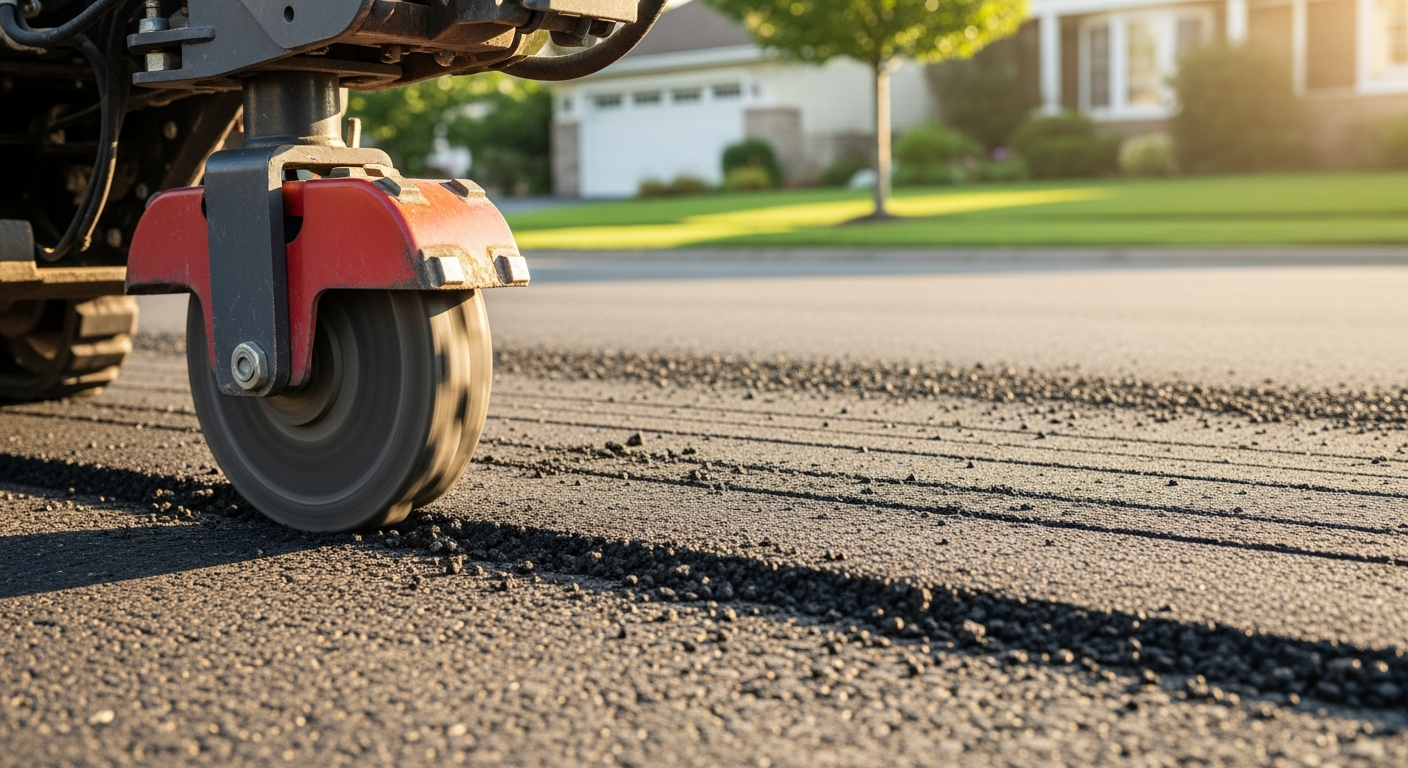
So how does asphalt milling work? A milling machine — a heavy piece of equipment with a rotating drum covered in carbide teeth — grinds off the top layer of asphalt to a precise depth, usually between one and three inches. The machine can be adjusted to remove exactly the amount of material needed, whether that's just the worn surface or deeper layers with more extensive damage. The milled material, called RAP (reclaimed asphalt pavement), is collected and recycled for use in new asphalt mixes or as a base material for other projects.
One of the biggest advantages of milling is that it maintains proper height relationships around your property. If you've ever seen a driveway where a new layer was simply paved on top of the old one, you may have noticed problems: the surface is now higher than the garage floor, water drains toward the house instead of away from it, or the transition from the street is too steep. Milling removes the old surface first, so the new overlay sits at the correct elevation.
When is milling the right choice for your driveway? The key factor is the condition of the base underneath. If your driveway has surface-level problems — oxidation, minor cracking, roughness, or wear from years of use — but the sub-base is still stable and well-compacted, milling and overlaying is usually the most cost-effective solution. On the other hand, if you're seeing deep structural cracks, significant sinking or heaving, or areas where the base has washed out, a full replacement with new base material is the better long-term investment.
Milling is also the preferred approach in many commercial applications. Parking lots, for example, can be milled in sections so that businesses can stay open during the work. The milled surface is drivable immediately, so there's minimal disruption even during multi-day projects. For municipalities, milling is commonly used on roads before resurfacing to maintain curb heights and drainage patterns.
The environmental benefits of milling are worth mentioning too. Asphalt is one of the most recycled materials in the United States, and milling is a big part of that. The RAP material generated during milling is almost always reused — either mixed into new hot-mix asphalt or used as aggregate for road bases and shoulders. This reduces the need for new raw materials and keeps old asphalt out of landfills.
At John & Jerry, we use professional-grade milling equipment and experienced operators to ensure a clean, even surface every time. If you're not sure whether your driveway needs milling, a full replacement, or just some patching, give us a call. We'll come out, take a look, and give you an honest recommendation — along with a free estimate.